After leaving Tangkoko Reserve we passed by a small coconut processing operation where we learned about how many uses there were for coconut trees. The wood from the trunk is used for furniture, the roots are used as coals for kilns, the husk is used for fire wood, woven mats, and filling for upholstery and then of course there is the meat, juice and oil all used for consumption. What a useful tree.
Moving on, we entered a small town where we saw many homes with cloves drying on tarps outside on the patios. We were also taken to a cemetery where the government had moved many ancient tombstones.
Leaving the town behind, we made our way up through the Minihasa highlands. We stopped by a couple of caves that were used by the Japanese during WW11. Inside the caves were several tunnels. Shining my light into one of the tunnels I noticed several pairs of beady red eyes staring back at me from the ceiling and walls. Upon closer inspection we discovered they belonged to huge rather ghastly looking spiders. Our guide assured us that they weren’t poisonous – still we all jumped when one of them scampered toward us while taking its picture. Another one of the caves inhabitants was swallows. These were the swallows whose nests they use for birds nest soup. There were several nests along the ceiling with baby birds in them.
From the caves we continued up through a stunning array of agricultural settings. There were immaculately terraced gardens that sported a wide variety of vegetables. Spice trees (clove, vanilla, nutmeg, and cinnamon) were growing right beside the road.
Our next stop was a traditional Minihasan market. This was the first of our sights that revealed some startling cultural differences. There was a lovely display of many fruits and vegetables, but when we came to the meat section there were fruit bats and dogs. Our guide confirmed that many of the people eat bats, rats and dogs on special occasions. Sometimes they even eat their own dog, but often they will go to a neighbor or another village and request to purchase someone’s dog. He said sometimes they also eat cats, but that the cats are less often consumed as they are considered useful in controlling the rat population. Hmmmm….. Ok moving on to a happier topic.
As luck would have it (with us all feeling slightly nauseous), our next stop was lunch. We stopped at restaurant on the banks of a large lake. Luckily, we had no unidentifiable meat on the menu. All around the lake were homes with fish farms and oddly there was almost nobody out on the lake.
We had 2 more stops to try and squeeze in as our incredibly full day was coming to an end. We breezed by Lake Linow known as the color changing lake. It is a volcanic lake that changes color from red to yellow, green, and blue. It is surrounded by exotic looking pine trees and has beautifully manicured grounds – perfect for a picnic.
Our final stop was to see prefab traditional Indonesian-style homes. They can be purchased for $5000.00 - $20,000.00 depending on the size and shipped anywhere in the world. They are made primarily from a local wood called Iron Wood.
Whew!!!! It was a lot of things to see in one day, but what an incredible experience.
Tuesday, September 28, 2010
Tangkoko Nature Reserve North Sulawesi
After a fabulous week of diving at Tasik Ria, we left the splendor of the Celebes Sea and headed for the hills – the Minihasa Highlands to be exact. First we traversed the island to Tangkoko Nature Reserve where we hoped to view Tarsiers (one of the smallest primates in the world), Black Macaque Monkeys, Great Hornbills, and Fruit Bats.
We started our tour at 4:45 P.M. after checking in at Mama Roos Homestay (a basic accommodation located just outside of the reserve). We headed off on a dirt road, but quickly moved off into the brush at the side of the road. We were forewarned about the abundance of biting midges or chiggers, so were we well armed with DEET. Along the way our guide handed me a piece of fruit he picked from a tree. It turned out to be wild guava. It was delicious!
Eventually we arrived at a large Fichus tree, where we were told to wait with flash lights, and cameras standing by for the star attraction of the night – the Tarsiers. It wasn’t long before the first little guy poked his head out. At that moment everyone fell instantly in love. Its huge bug eyes, little turned up nose, expressive (Yoda-like) ears, and perpetual smile elicited a collective awwhh!!!! One after another the rest of them appeared and went on about their business seemingly unaffected by our presence. Our guide informed us that they can jump up to 3 meters and perform 360’s while jumping from tree to tree.
We started our tour at 4:45 P.M. after checking in at Mama Roos Homestay (a basic accommodation located just outside of the reserve). We headed off on a dirt road, but quickly moved off into the brush at the side of the road. We were forewarned about the abundance of biting midges or chiggers, so were we well armed with DEET. Along the way our guide handed me a piece of fruit he picked from a tree. It turned out to be wild guava. It was delicious!
Eventually we arrived at a large Fichus tree, where we were told to wait with flash lights, and cameras standing by for the star attraction of the night – the Tarsiers. It wasn’t long before the first little guy poked his head out. At that moment everyone fell instantly in love. Its huge bug eyes, little turned up nose, expressive (Yoda-like) ears, and perpetual smile elicited a collective awwhh!!!! One after another the rest of them appeared and went on about their business seemingly unaffected by our presence. Our guide informed us that they can jump up to 3 meters and perform 360’s while jumping from tree to tree.
On our way back from the Tarsier encounter we passed by a brown tree snake and 2 Tarantulas.
The next morning we were up at 4:30 A.M. to see the Black Macaque Monkeys, Great Hornbills, and Fruit Bats. We got skunked on the Fruit Bat sighting and had only a fleeting view of a Great Hornbill as it took off - never to return. We were taunted periodically throughout our hike with the sound of its massive wing beat. The heavy whoosh, whoosh, whoosh sounds like it might belong to something the size of a Pterodactyl.
We located a large troop of Black Macaques chattering up in the canopy. We waited patiently and after
about 15 minutes they all descended upon us to begin their morning foraging. Like the Tarsier, they too seemed unaffected by our presence and approached within a couple of feet.
We spent about 5 hours traipsing around the reserve, stopped briefly by Mama Roos for a quick bite and a shower, then piled into our Zebra-stripped van and sped off to our next series of adventures.
Monday, September 13, 2010
North Sulawesi Adventure
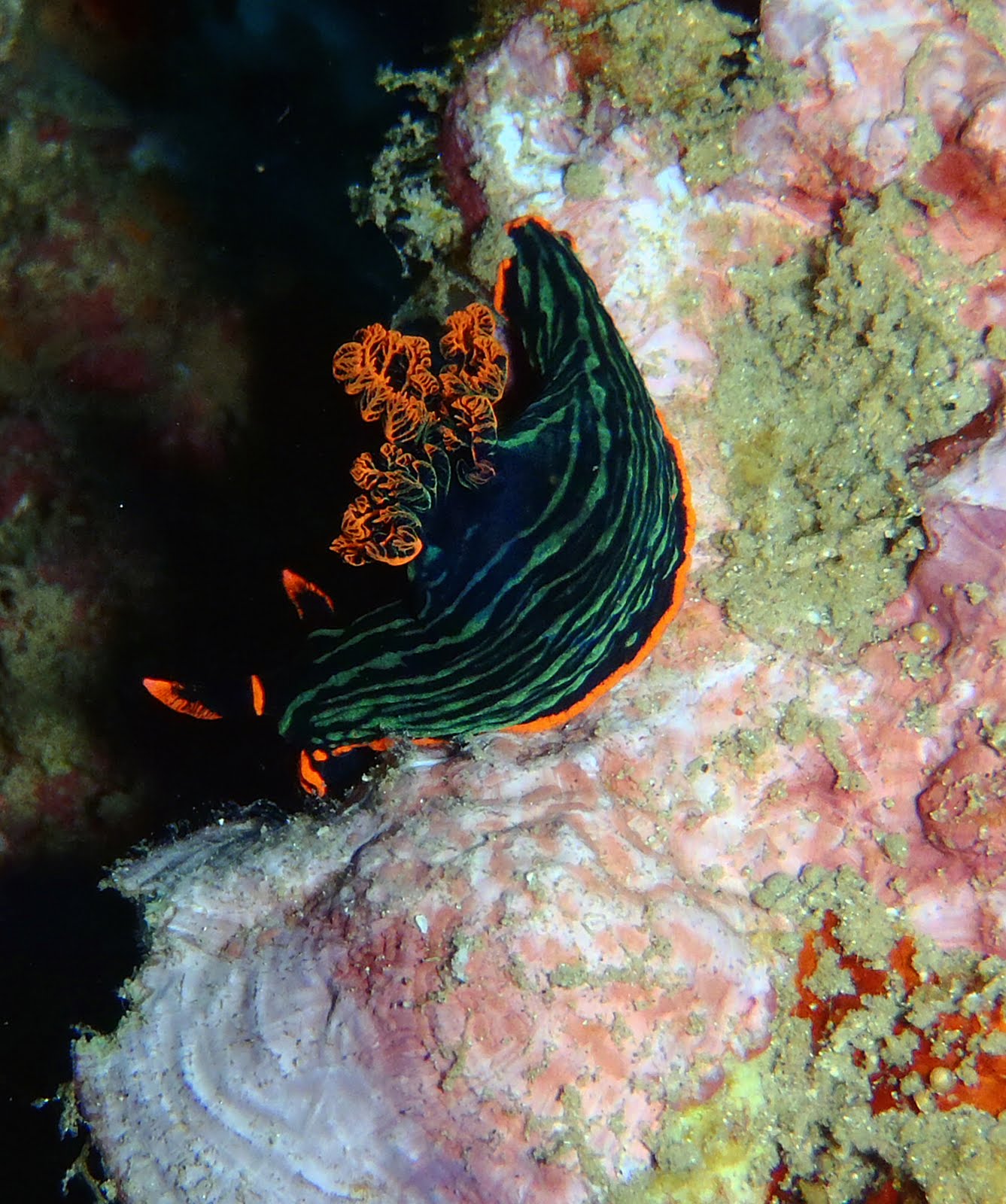
We have just completed our first week of adventure in Sulawesi at Tasik Ria Resort. We had a fabulous 6 days of diving. Bunaken National Park is a nice mixture of wall dives, sloping reefs, and muck diving. There are a large number and variety of fish here including: monster Napolean wrasse, and massive schools of Butterfly Fish - a cascade of brilliant yellow pouring over sheer walls into an indigo abyss. Every day we encountered a multitude of new and amazing critters like: the Pegasus Sea Moth (looks like a Sea horse with wings), the Crocodile snake eel, and the most exotic Sea Cucumber I’ve ever seen – I dubbed it the Warrior Sea Cucumber.
The staff at Tasik Ria are all warm and friendly and are quick to attend to any needs or requests. The resort is in a lovely tropical garden setting and the sunsets from the jetty bar are breathtaking. The weather has been a mixture of sun and some tropical afternoon and evening showers. The day before we left, we got to experience a real toad choker of a tropical downpour. That day we got to wade through ankle deep puddles around the resort.
Today we head out to Tangkoko Nature Preserve to see Macaque Monkeys, and the Tarsier Monkey (words smallest primate). This will be a night hike in the jungle, as that’s when the little guys come out to feed. From there we move on to the Minihasa Highlands to see some local culture, markets, and mountain lakes. Stay tuned for the next blog highlights that will include reviews and photos of Tangkoko and Minihasa.
Sunday, June 13, 2010
Dominica Photos
Sperm Whale
Colors of the Caribbean
Trafalgar Falls
Swimming into Titou Gorge
Sunset on Dominica
Hiking up to Boiling Lake
The Boiling Lake
Dominica Adventure
Looking out across the landscape from one of Dominica’s towering peaks, I had a sense of discovering something that had managed to escape the domination of man and thus remained a pristine jewel in a vast indigo sea. Dominica is the tallest island in the Eastern Caribbean reaching a height of 4,747 ft. It has 365 rivers and the largest oceanic rainforest in the Caribbean. A large portion of the island is sparsely populated, making for a whole lot of green. For this it is commonly known as the nature island.
On our recent trip to this verdant isle, we stayed at a funky little place on the water called Castle Comfort Lodge. We found the staff to be both friendly and helpful. One of our guests even learned some new knitting techniques from the bartender. Our package included two boat dives, unlimited shore diving and breakfast daily.
The diving was great even though visibility was less than the norm (about 60 ft.). We saw new and interesting critters on most dives. There were huge barrel sponges and a multi-colored array of delicate crinoids on every dive, making for a picturesque landscape. We saw large turtles and multiple free swimming eels of various types on many of our dives.
My favorite critter on this trip was the basket-starfish. I first encountered it on a day dive, when I peered into a large sponge and noticed what looked like a tangled mass of black arms huddled near the center of the sponge. I speculated about the possibility of this being some kind of alien. It looked a little like something I’d seen on Star Trek. When I saw the creature again on a night dive, it had grown to twice its original size, crawled out of the sponge’s core and was waving its tentacles around wildly. Definitely alien!
One of the other unique creatures that can be seen in Dominica is the Sperm Whale. They have a resident pod there. I had crossed my fingers prior to our arrival in hopes that we would catch a glimpse of at least one on the afternoon of our whale watching tour. I was not disappointed. We had several sightings on our tour including, two close encounters with a female that seemed as interested in us as we were in her.
In addition to diving, Dominica offers spectacular hikes with a multitude of cascading waterfalls surrounded by lush tropical vegetation. There are options available for every level of fitness, ranging from an easy 10-15 minute walk to a waterfall that plunges into an iridescent pool, to a strenuous 6-7 hour hike that involves over 7000 steps, crab crawling up rock faces, leap-froging across boulders strewn throughout steamy creek beds and ends up at the worlds second largest boiling lake.
We chose the strenuous option on our last day in Dominica and for two days afterward, I hobbled about, cursing every step I took. Was it worth it? I would have to say, now after regaining my mobility - yes. It was a painful challenge with breathtaking scenery; a truly unique adventure that should be experienced at least once, if one is physically able. This is not a hike for anyone who has significant knee, back or hip issues, or is not at least moderately aerobically fit. There is a pay off at the end of this trek called Titou Gorge. It is a cool refreshing pool that disappears into a tunnel which you must swim through to reach a series of waterfalls. The swim is short - less than 5 minutes, but there are some areas where one cannot touch the bottom. For those who are not confident in their swimming ability, it is advisable to bring some sort of flotation devise.
There are a wide variety of activities available on the island, making it difficult to choose if one only has a week. If you love nature and outdoor activities, you will love Dominica.
General information: Language spoken on the island is English. Currency is the Eastern Caribbean dollar which was approximately 2.6 to 1 exchange rate at the time of our trip. They also accept U.S. dollars. Pearls in downtown Roseau is a great place to go for tasty, affordable local cuisine. There are no see-ums, so bring your bug spray or Avon Skin So Soft. Driving is on the left. Be aware of when the cruise ships arrive and plan your tours accordingly.
Friday, June 4, 2010
The Dominica Adventure Begins!
We were greeted with beautiful weather on our arrival on Dominica. Mostly flat seas this week with visibility at 50 to 60 feet. The outside temperature has been a comfortable 86 degrees, with the water temperature at 82 degrees. The reefs are healthy and colorful. Lush green mountains descend to the gorgeous blue water. Stay tuned for a detailed narrative of the underwater and land adventures.
Tuesday, January 19, 2010
Thursday, December 3, 2009
Subscribe to:
Posts (Atom)