Sunday, December 9, 2018

Return to La Paz!


This year in La Paz, we were blessed with the best weather we have ever had there. The sea was calm with a glassy surface, minimal current and good visibility. We also had a couple of exceptional first time underwater sightings.


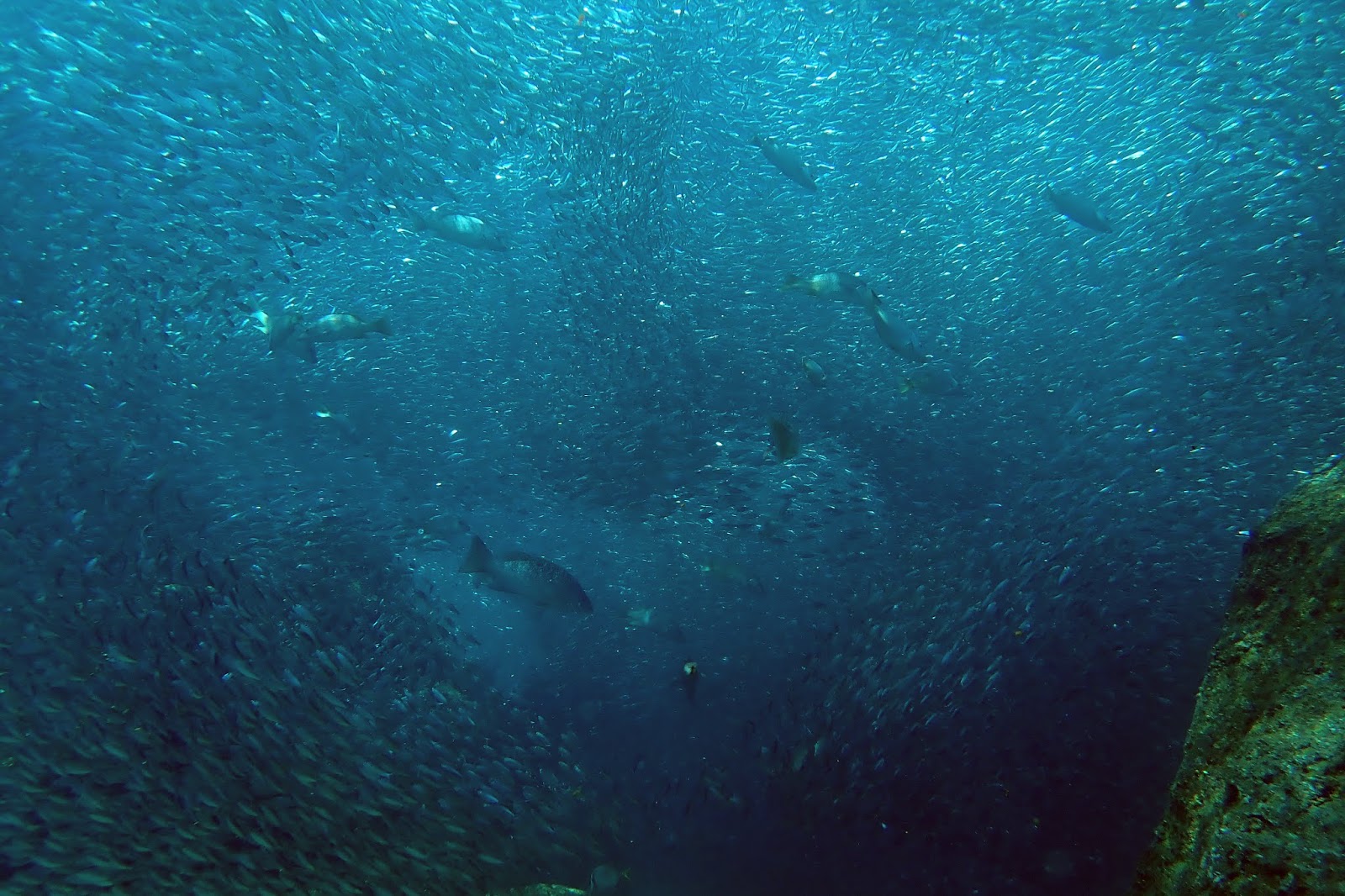
At Los Islotes we were delighted to frolic with playful Sea Lions, but were even more blown away by the massive bait ball of Sardines that were there shape shifting around the island.


Another first was the night Mobula Ray dive.


Here we descended to about 40 feet and gathered around an eerie green light that attracted millions of tiny fish and other microscopic critters. Sting rays and Puffer fish scooted around munching in the sand at our feet, while squadrons of rays jetted in from the darkness swooping around us in a feeding frenzy.
In addition to these exciting dives, we also explored 4 different wrecks and snorkeled with Whale Sharks.


The Sea of Cortez always delivers exciting marine encounters and just when you think you know what to expect, it delivers another surprise! That is why we keep coming back.


Runs with Sardines


Imagine being engulfed by a massive school of millions of Sardines! Every way you look nothing but shifting, shimmering, silver forms. The effect is hypnotic, a one of a kind phenomenon I will never forget.

The following is my extraordinary experience with this event just off shore at Panagsama Beach in Moalboal on the island of Cebu in the Philippines.

Unlike other places in the world the Sardine Run here can be witnessed throughout the year. The school used to be found off of the Pescador Island, but has now moved closer in and can be found in 12 – 40 feet of water just off the beach at Panagsama.

We stayed at Kasai Village Resort, a place I highly recommend due to its convenient beach front location, close proximity to dive sites (including the Sardine Run), a house reef loaded with an array of unique critters and the occasion passing Whale Shark, friendly staff and impeccable service.

Read on to discover what it’s like to run with Sardines.

Runs with Sardines”

For the first time in 30 years of diving, I lost my buddy. They warned us about this potential problem during the dive briefing of the “Sardine Run”. They advised us to keep a close eye on each other as the sheer density of the mass of Sardines can completely consume your field of vision. What they didn’t say was - “Oh by the way, this experience is completely mesmerizing and you may succumb to a phenomena that I dubbed “Sardine Hypnosis.” Of course by the time you realize that you are under their spell, you may have been swept far, far away from your group, especially if there happens to be a little current.

I felt like one of those cartoon characters with spinning eyeballs. The lens of my camera became a kaleidoscope through which I was drawn deeper into the silver cyclone. The shimmering art display poured downward, shot upward, darted sideways and diagonally and then exploded like fireworks before my eyes. The lure of their movement was irresistible – I simply couldn’t take my eyes away.

By the time I came to my senses and realized it had been a few minutes (maybe more) since I had consciously looked for my buddy, he was nowhere to be found. It was just me and the massive school of Sardines I had taken up with. Lucky for me, by the time this happened I had actually worked my way up into only 12 feet of water. I followed standard lost buddy procedure and looked around under water for 1 minute prior to surfacing. No bubbles, no divers – I rose to the surface and noticed our dive boat far off in the distance. I inflated my safety sausage and waved toward the boat and to the guy on shore who was looking in my direction.

Shortly thereafter Krish, our Divemaster popped up out of nowhere next to me. I apologized for losing my mind to the Sardines and we waited together for the boat. I was reunited with my buddy on board the boat, reoriented but just a little giddy. Still, when I watch my video footage of this spectacular phenomena I am entranced.
Watch the video of this experience by clicking the link below.


Friday, July 19, 2013

Mayan Adventure


Mayan Adventure


Imagine snorkeling with up to 100 Whale sharks in one location. We were privileged to have this experience on our recent trip to Playa Del Carmen.

Every year between the months of June and September, hundreds of Whale sharks migrate to the waters off of a tiny island in Mexico called Isla Mujeres to feed on plankton, small fish and fish eggs.

Seemingly oblivious to the excited snorkelers splashing about on the surface, these gentle giants cruise lazily about with their mouths wide open sucking in huge amounts of water and the nutrients that it contains.

Occasionally they will turn their bodies erect in the water column (a technique called bottling) and become like a giant funnel.

Dave and I have been fortunate to have encountered Whale sharks on several of our previous dive trips, but never have we experienced the vast number of creatures that we encountered at Isla Mujures. It is an experience not to be missed.

Equally mind-blowing was the other-worldly beauty of the cenotes. We visited “Chac Mool” and “Kukulkan”; two cenotes that are located side by side.


We descended through bent light rays that shown through crystal clear water from the jungle above and pointed the way to a sanctuary of Mother Earth, adorned with stalactites, stalagmites and fossils from another time. Giant tree roots pierced the ceiling of an air dome, spreading out in a web-like fashion in search of the water below to quench their thirst.

Near the center of the darkened room a single spot light shown from above. It beckoned me to take center stage in the grand cathedral and I of course humbly obliged.

Where fresh water mixes with salt water a phenomenon known as a “halocline” exists which creates a blurry shimmer like a mirage or like oil in water. As we swam through this section of the cenote, I felt as if I was passing through dimensions to perhaps a parallel universe. At one point I rose above the halocline layer and gazed out across what appeared to be a vast lake in the middle of the water column. The water above it was so clear, it could have been air.

Wow, it gives me chills just thinking about it! Suffice it to say, it was a breathtakingly beautiful experience – another one not to be missed by those of us who venture below the surface in search of other worlds.

In addition to these two (my favorite) experiences, we also explored an underwater museum off of Isla Mujeres where they have placed hundreds of sculptures designed by a local artist for the purpose of creating an artificial reef. Here, the sea has begun to claim the sculpted figures giving them an ever so slightly spooky appearance, as they have things growing out of their eyes, ears, nose, etc.


We encountered lots of Hawksbill turtles, large schools of Grunts, many Green and Spotted Moray Eels, several small rays, some Giant Parrot Fish and a couple of creatures we have yet to identify.

Our resort had good food with lots of variety, a large white sand beach for strolling in the surf or swimming in case you need a little more time in the ocean. There are multiple activities available, so one can choose to be occupied with many different options or not. It is conveniently located to many of the Riviera Maya attractions.

We will more than likely be organizing another trip here in the next couple of years as I would really like to explore more of the cenotes and some of the Mayan ruins that I have yet to see and of course I would love to swim with all of those Whale sharks again. If you find that you are so excited by the tales of this adventure and just can’t wait for our next group trip, we can arrange the same adventure for you or your group anytime.


Monday, April 1, 2013

Superhero Divers Go To Bonaire!


 We began our trip to Bonaire with a frenzy of phone calls to our band of “Superhero Divers”, after learning (the night before our departure) that our flight to San Francisco had been cancelled. That never happens! We scrambled to find a variety of options to reach San Francisco within a time frame that allowed us to connect with the rest of our flights. Six of us drove to SF, one drove to Eugene to connect with a flight that went through Newark, Atlanta and finally reached Bonaire the following afternoon. The remainder of the group arrived on delayed flights through Medford and St. Croix.  In true superhero form (adapt and overcome) we all made it to our destination.


We settled into our lovely beachfront accommodations at Captain Don’s Habitat and began the routine of island life: up early for a good breakfast, out to the dive boat for a day of cruising the reef, searching for critters, back in time for lunch followed by a nap, up in time to sip Gin and Tonics while watching the sun go down and then off to eat again. It’s a rough life!

During this particular trip we were also treated to nightly live music by two of our group members Bob and Eric who took turns playing guitar and singing songs that we all knew and loved. Thanks guys that made it extra special!

The name of the island Bonaire, comes from the indigenous word Bonai meaning flat and it is in fact a mostly flat, cactus covered coral island inhabited by an eclectic mixture of abundantly happy folks as well as wild (or free as the locals call them) donkeys and goats.  The island is surrounded by the clear turquoise waters of the Dutch Caribbean off the coast of Venezuela.

The island is considered to be one of the best around the world for shore diving as there are numerous easily marked and accessible dive sites and many operators that rent trucks to cart your gear around the island.

The reefs were healthy and the fish were plentiful. We saw a large variety of eels, File Fish, Trumpet Fish, Angel Fish, Parrot Fish and Hawksbill Turtles. We were also treated to nightly visits from a Manta and Tarpon that would cruise the shore every evening around supper time. Several Tarpon were also spotted on the wreck and night dives.


 Some of our group tried and fell in love with a unique kind of night diving called “Fluoro Night Diving”. We were equipped with amber colored visors that fit over our masks and given UV lights that cast a blue ray of light over the reef and caused the coral and many of the critters to glow bright yellow, and green. It is positively psychedelic – a must try if you go to Bonaire. Bon Photo located at Captain Don’s offers this spectacular tour for $50.00.

Another fun side trip that some of us tried was the cave tour with BonPhoto. This tour includes one dry cave and one wet cave. Bonaire has an estimated 400 caves on the island but only a few are open for exploration.

We began our tour in the dry cave by rappelling down approximately 15-20 feet into the cave. We were warned that the dry cave could be quite hot and humid as they are made of limestone and coral which does not insulate the interior like materials that compose other types of caves which are cool and dry. As we progressed through the cave it became more and more like a sauna or sweat lodge. The cave had fossils of brain coral embedded in the ceiling as well as stalactites, stalagmites.

The second cave that we explored was a wet cave that contained pools of rain water (approximately 5 ft. deep) that we swam through to explore the caves interior. At 80 degrees, the water was a refreshing follow-up to our previous sauna experience.

Our last day on Bonaire, we signed up for a land based tour of the island. We all piled in an older white Econoline Van and headed out to experience the island above the water. We visited Goto Meer, and Slagbaai National Park where we saw Flamingos, Parakeets, Parrots, and beautiful turquoise and grey lizards. We also saw wild donkeys, goats and lots and lots of cactus! 

Speaking of cactus, on the way to Slagbaai National Park we stopped at a distillery named “Cadushy” in the town of Rincon. The signature liqueur produced there is called Cauchy and is made from cactus and lime water. Here you can taste and purchase the product if you like. They also produce liqueurs with unique flavors from neighboring islands including spices for Saba, Agave for Aruba, and Calbas for Curacao.

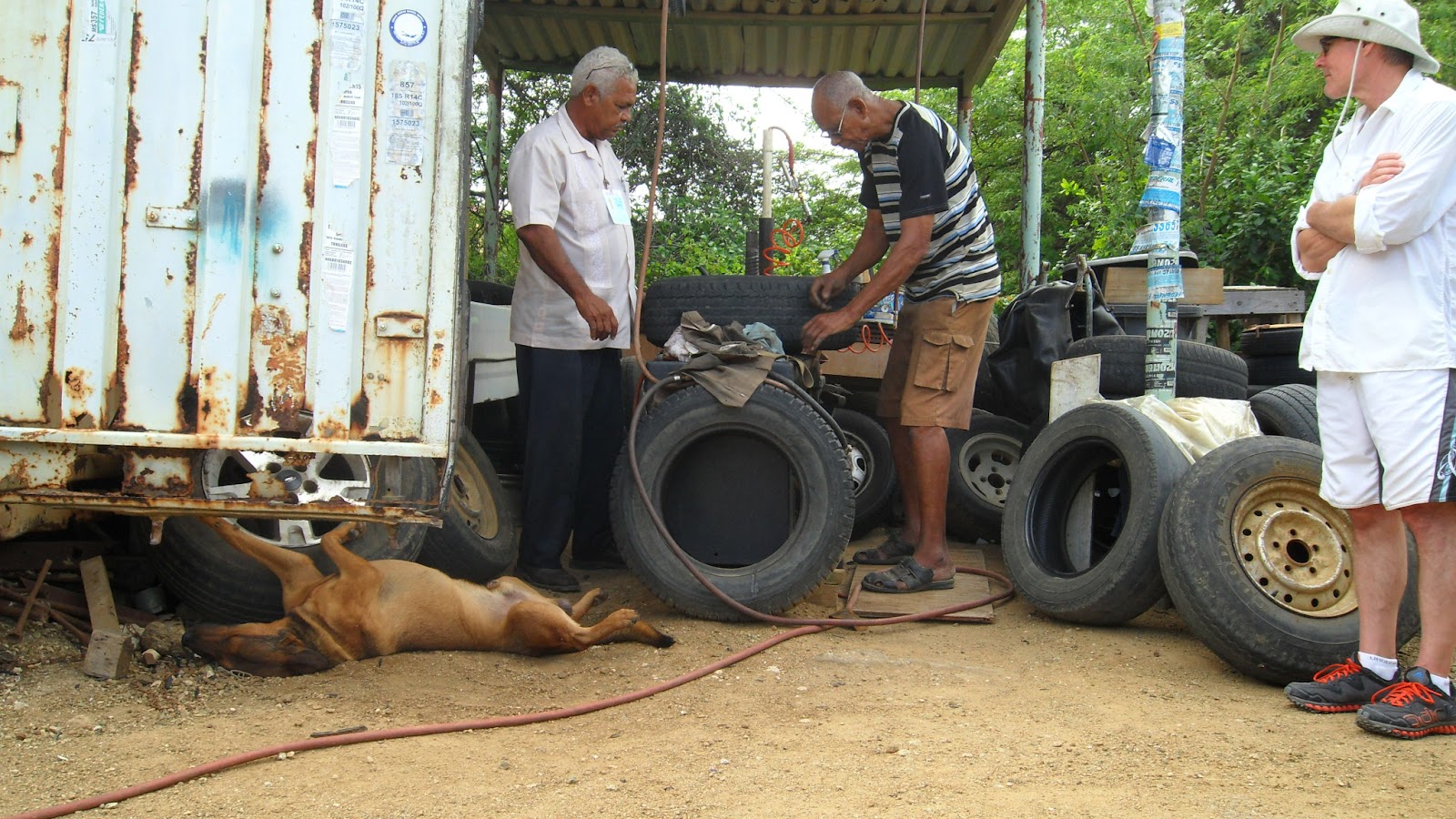
We wrapped up our circle island tour in Slagbaai National Park where we saw several flocks of flamingos and visited several beaches. It turns out that Slagbaai is a really large National Park accessed by dirt roads that have a lot of sharp rocks/coral on them. Near the end of our tour we or should I say the tire of our van had a close encounter with one of these nasty little nuggets and it decided to go flat. "Aawwhh", groaned our driver, "that’s not good!" We pulled to the side of the road and everyone piled out. We confirmed the tire was flat, checked the spare and it was flat….hmmm! 

Our driver climbed up a very small hill and tried to get a signal on his cell phone to call for help. No signal! Hmmm!!!! This is when we got to experience the good-hearted nature of our fellow divers/buddies from Buddy Dive Resort (the ones with the trucks). They were able to collect the majority of our group and return them to our resort. Thanks guys! The four of us that remained with the driver were soon rescued by the rangers that were alerted to our dilemma by the others. They came in their truck with a retrofitted scuba tank to fill our flat tire. 

What transpired after that was something like a day at the racetrack. The drill went something like this; the rangers would fill the tire, we would all pile in the van and tear down the road until the rangers following behind us would honk, we’d stop and they would run up fill the tire again, whistle and off we’d go. It was like having our own personal pit crew. Eventually, we made it to a friend of the ranger’s tire shop where the tire was repaired. It was a hoot and an unexpected way to experience the great team work and camaraderie of the island people and our fellow divers.

We made it back to the resort in time for one last sunset and a toast to the great week we had on the island of Bonaire.

To view photos and video of this trip visit our website at www.vagabondventurestravel.com and look in the photo gallery section under Bonaire. If you or someone you know is interested in a trip to Bonaire and would like more information, contact us at info@vagabondventurestravel.com or call 541-951-2223 and ask for Becky or Dave.

Wednesday, December 14, 2011

Haras Cerro Punta

Day 4 Haras Cerro Punta

Today we visited a farm where they breed and raise Thoroughbred race horses called “Haras Cerro Punta”. They have 140 horses total including: 5 Thoroughbred stallions, 65 Thoroughbred mares, and 1 Percheron stallion called “Centurion” - the remaining are yearlings.                                                   

Breeding takes place during the months of February-March and the newborns arrive 11 months later. The mares give birth to their fouls in a laboratory/clinic located in the basement level of the main house. Artificial insemination is illegal in Panama, so all offspring are conceived naturally. There is an on-site veterinarian 24/7.


The fouls are started in gate training at 5 months old. Here they are fed their daily rations in an enclosed area designed to acclimatize them to being in the starting gate. Race training begins at 17 months and utilizes a rotational running machine designed to get the horses used to running in an enclosed space. The horses are exercised daily at this higher altitude location (2000 meters) in order to develop greater lung capacity and endurance. At 2 years of age they are taken to Panama City where they are sold at an auction that takes place at the Hipodromo Presidente Remon Racetrack. The horses race from 2 to 6 years of age.

4 of the Thoroughbred stallions here are from the United States and one champion called “Figo” was born and raised at Haras Cerro Punta. The 6th stallion residing here is “Centurion”. He is a 13 year old 2300 pound, majestic Percheron. He has a shiny jet black coat and a fabulously wavy mane and tail. Not only is he handsome, but he is also extremely good-natured and they will let you take a short ride on him if you want to give it a try.

Tours are available at the farm daily from 8:30-5:30 and cost only $5.00. This is a great opportunity for anyone who wants to see some beautiful horses and learn something about the lives of racehorses.


Day 3: Finca Dracula

Day 3 Los Quetzales

Today we visited “Finca Dracula”, a local Orchid farm named after the rare Dracula Orchids. The farm was founded in 1969. It sits on 10 acres, 5 of which are greenhouses and gardens. The farm has 2200 different Orchid species from around the world, 115 of which are the Dracula variety. Currently the Orchids here are for exhibition only.


We took a 20 minute tour and learned many things about the plants and how they are grown. I emerged with a much greater appreciation for the lovely flower. First we learned that the process from pollination to flowering plant takes 5 years when grown commercially. It takes 15 years in nature. It takes 12 months to make a mature seed capsule that produces millions of seeds. In nature, a fungus called Michoriza provides nutrients for the maturing seed. In the nursery they use Agar as a substitute for the fungus. We also learned the different techniques each type of flower uses to attract potential pollinators. Some use smell while others use a visual attractant like mimicking a female insect. Some of them trap their pollinators causing them to become agitated and release the pollen inside the plant.